Stories
Cranes Live a Thousand Years, Turtles Ten Thousand: Why Turtles Mean Longevity in Japan
The messenger of Mt. Horai, the guardian deity Genbu, and the moss-tailed minogame — how turtles came to symbolize long life in Japanese art.
Wedding kimono, Noh fans, lacquered boxes — turtles appear in Japanese art with remarkable frequency, almost always paired with cranes and framed by pine, bamboo, and plum. The proverb says it all: “Cranes live a thousand years, turtles ten thousand.” For centuries, the turtle has been Japan’s emblem of longevity and good fortune.
The roots reach back to ancient Chinese mythology. Far across the eastern sea, the story goes, lies Mt. Horai (Penglai), a paradise of immortals — carried on the back of a giant turtle. When this legend reached Japan, the turtle became an auspicious messenger from the land of eternal life. And in fairness to the legend: turtles really are exceptionally long-lived, with many species passing the century mark. “Ten thousand years” was an exaggeration in degree, not in direction.
Among the Four Guardian Deities of the cardinal directions, the north is protected by Genbu — depicted as a turtle entwined with a snake. Genbu appears in the 7th-century murals of the Kitora Tomb in Nara, meaning the turtle’s career as a sacred beast in Japan spans well over 1,300 years.
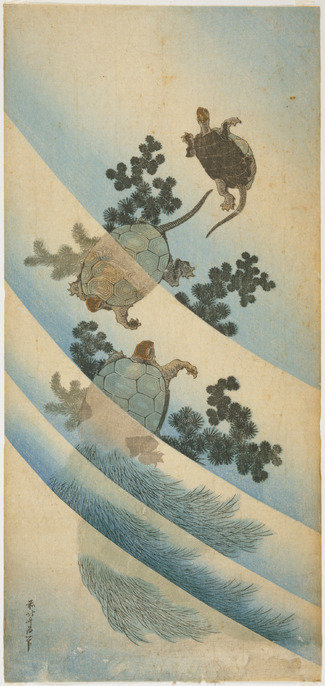
Japanese artists especially loved the minogame, the “straw-raincoat turtle”: a turtle so old that algae trails from its shell like a flowing cloak. Hokusai painted one in his print of turtles drifting through sunlit water. Since real turtles do grow algae on their shells, the minogame is a very Japanese blend of observation and imagination.
The hexagonal pattern of a turtle’s shell also became kikko-mon, a traditional motif found on treasures as old as the Shosoin repository — and hidden, if you look closely, in the shell of Kamepedia’s own logo.